Research for Better Quality of Urban Life: the Build4People Project

The Build4People project aims to research and promote the use of sustainable buildings and sustainable urbanization through re-configuring the urban transformation pathway of Phnom Penh. Thereby, it focuses on people’s aspirations and their behaviour. The project is funded by the German Federal Ministry of Education and Research (BMBF).

Project Objectives

Our project promotes sustainable buildings and sustainable urban development from a people-centred perspective. We aim at lowered greenhouse gas, pollutant emissions, a better indoor environment, an increase of urban green, a healthier urban climate. Read more.

Project Originality

The trans-disciplinary Build4People project connects scientific-conceptional and analytical aspects. The superior normative bracket is always the urban quality of life. We align people’s needs and aspirations with tools to benefit their living. Read more.

Project Relevance

Cambodia’s traditional architecture took climate conditions into account. Today dynamic economic growth affects the way buildings are built and operated which is not energy-efficient nor tropical climate adapted. Reasons enough for B4P. Read more.

Project Set-up

10 partners across continents join forces to implement 7 work packages: from Behaviour Change, Sustainable Buildings and Neighbourhoods, to Urban Green, Urban Climate to Sustainable Urban Transformation and Coordination. Read more.

Project Approach

The Build4People project considers sustainable, people-centred urban development as a crosscutting task. A genuinely people-centred planning system can neither be expected to “evolve by itself” nor is it feasible through legal regulations only. Our diverse team includes Cambodian and German partners which cooperate on a trans-disciplinary basis. Together they will develop innovative concepts aimed at urban sustainability that are based on scientific and regional expertise. The integrating link of our scientific-conceptional, analytical and normative dimension is the urban quality of life, which we consider to be the general foundation for our people-driven approach. The research consortium will carry out field research together with the most renowned local universities. Based on these insights, context-specific interventions will be implemented together with a number of core actors most important of all the Phnom Penh Capital Hall and the developer company Peng Huoth Group. Locally established multipliers such as the European Chamber of Commerce or the Center for Khmer Studies will support the dissemination of our approaches.

A strong partnership to deliver research results

Academic Quality
We gathered a team with a proven record of academic excellence, extensive regional expertise and solid project experience.

Transdisciplinary Approach
We draw from expertise and methods from Human Geography, Architecture, Urban Planning, Enviromental Psychology, Civil Engineering, Remote Sensing, Geoinformatics and Climate Research.

Cross-border cooperation
German Universities and private sector actors collaborate with Cambodia partners from the academic arena, the municial setting and responsible ministrial offices.

Latest News

Stay up-to-date with our latest activities

Build4People formalizes cooperation with Phnom Penh Capital Hall by means of a joint Project Implementation Agreement

On 30 January 2026, the Vice-Governor of Phnom Penh, H.E. Vannak Senk, signed a so-called Project Implementation Agreement with the Build4People consortium lead, the University of Hildesheim.

After previous agreements with Cambodia’s largest university, the Royal University of Phnom Penh, the Paññāsāstra University of Cambodia, and the Cambodian Institute of Urban Studies, this was the last formal step to formalize Build4People’s cooperation with major Cambodian institutions during its concluding Implementation phase.

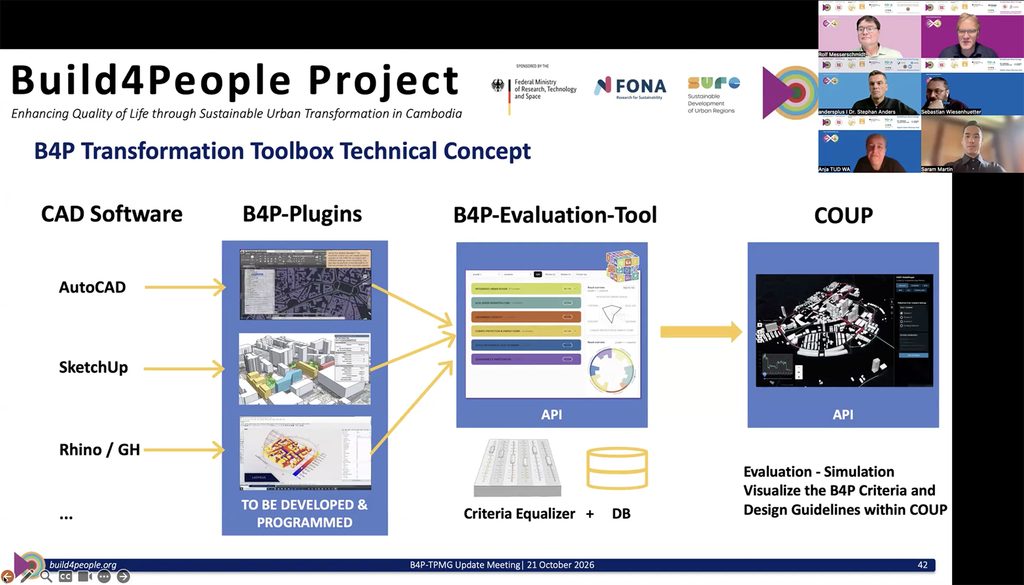
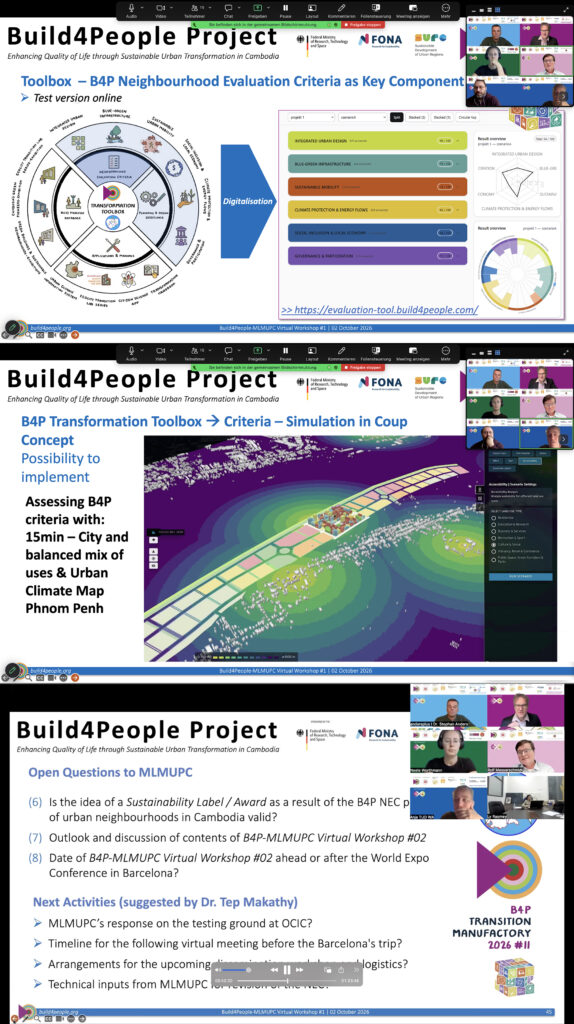
The core aim of the Project Implementation Agreement is to foster the digitalization of the B4P Transformation Toolbox as inter-active information-, public participation-, knowledge-, technology-, and learning platform supporting evidence-based data-driven decisions as well as scenario building towards sustainability and enhanced quality of life in urban Cambodia.

It also ensures the implementation of the follow-up format of B4P Ecocity Transition Lab series, the so-called B4P Transition Manufactory. Following the strategy of the so-called Twin Transformation this urban lab will facilitate Performance-Based Design (PBD) through infusing our B4P Transformation Toolbox Neighbourhood Evaluation Criteria and guidelines, to develop alternative (digital) visions of sustainable development based on a real urban development site and to conduct trainings in regard of the use of digital urban planning tools. Based on this, the final aim is to develop a parametric digital urban model, for the first time in Cambodia.

New Publication introducing about cooperation between Royal University of Phnom Penh and the Build4People project in regard of the B4P Citizen Science App

The Build4People project is very happy about a joint publication at the Cambodia Journal of Basic and Applied Research. The leading author is Dr. Bunleng Se from the Department of Geography and Land Management at Royal University of Phnom Penh (RUPP) with contributions from further Build4People team members.

This publication which got published as so-called editorial paper is generally dealing with the implementation of citizen science approaches among higher education institutions and their potential benefits in regard of research and lecturing as well as public participation.

The rationale behind is that traditional top-down planning approaches often fail to reflect lived experiences, especially in dynamically growing cities such as Phnom Penh. Against this backdrop, the implementation of digital citizen science tools allow the urban population to add subjective perceptions to objective metrics. Examples of such subjective perceptions would be thermal comfort, shading availability, or heat stress

More specifically, the paper introduces about the B4P Citizen Science App which got experimentally applied during a Build4People Transformation Workshop in early December 2025. Thereby, it was the aim to link subjective data gained through the App with objective data of measured environmental features. In our case, this combined approach enabled the app users to infuse their personal feelings of thermal comfort and perceived urban quality of life beyond pure measurement of (objective) weather data. The testing of the B4P Citizen Science App among Workshop participants took place at two sites of RUPP campus with distinct environmental features.

The results of the exploratory empirical survey showed that the use of such a citizen science app provides indeed valid data and that consequently the development of the B4P Citizen Science App should be further continued as joint implementation orientated project between the Build4People project team members and their colleagues from Royal University of Phnom Penh.

Infusion of Build4People’s transformative approaches into the 2nd batch of the Master Program in Urban and Regional Planning at Royal University of Agriculture, Phnom Penh

Build4People is very happy about the continued infusion of its transformative approaches into the Master Program in Urban and Regional Planning at Royal University of Agriculture.

Prof. Dr. Tep Makathy, Dean of the Faculty of Architecture and Urban Planning at Paññāsāstra University of Cambodia and Director of the Cambodian Institute of Urban Studies, is currently teaching the 2nd batch of students of this innovative course.

His course unit “Sustainable Urban Transformation” applies key principles of the B4P Transformation Toolbox, developed to support the Phnom Penh Capital Administration in implementing more sustainable urban neighbourhoods.

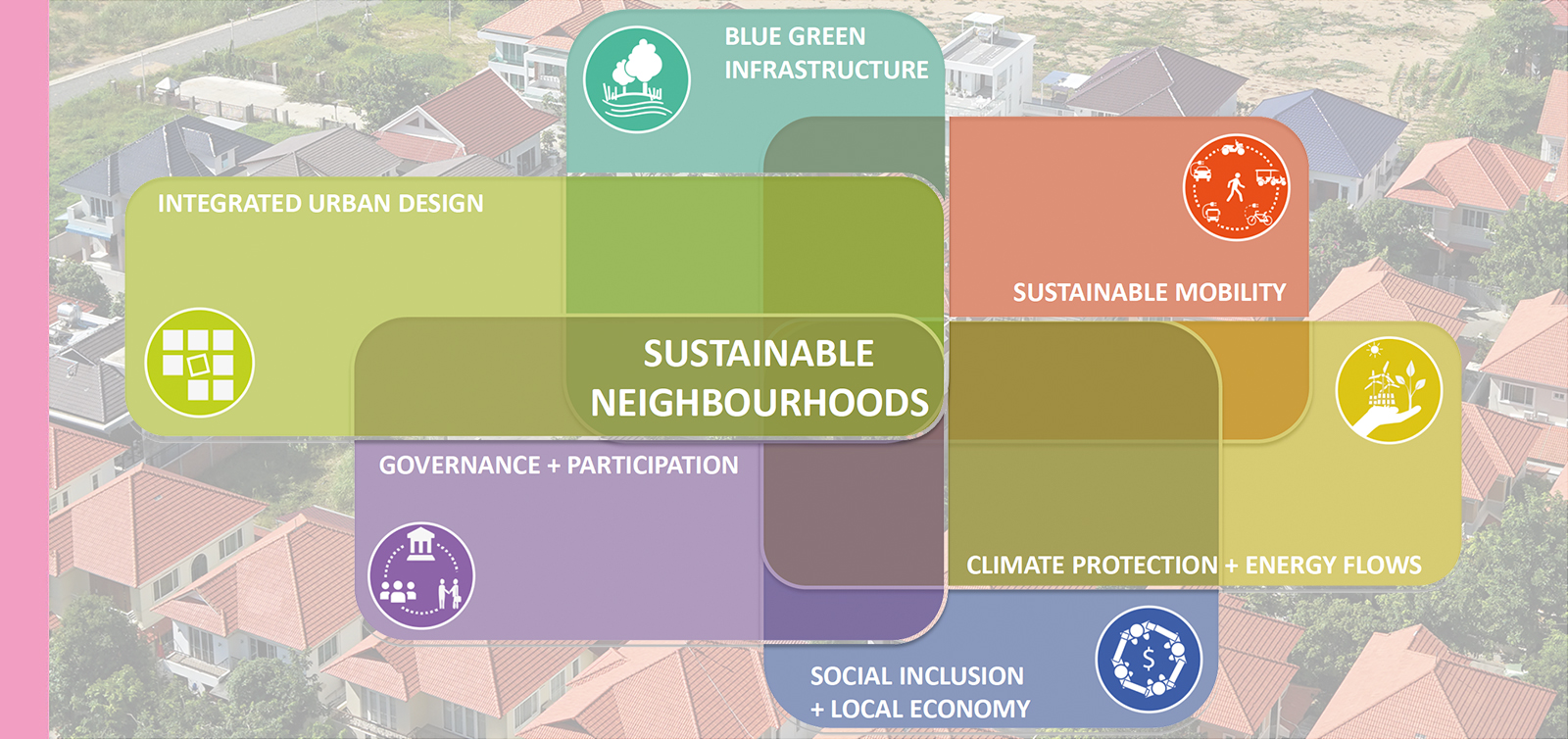
B4P Transformation Toolbox components include Neighbourhood Evaluation Criteria, the planning and design guidelines Integrated Urban Design,  Blue-Green Infrastructure, Sustainable Urban Mobility, Climate Protection & Energy Flows, Social Inclusion & Local Economy and Governance & Participation.

The course covers the fundamental principles of Build4People, such as the inclusion of interdisciplinary and transdisciplinary perspectives, a comprehensive understanding of urban planning as a transformative communication process involving multiple stakeholders, and a general advocacy for putting people and sustainability at the center.

All in all, it should be emphasized that the integration of Build4People’s comprehensive transformative formats into the curricula of local master’s programs, such as at the Royal University of Agriculture, is considered an extremely valuable and sustainable outcome for the Build4People project, as the continuation of the Build4People project approaches is expected to have long-term effects even after the end of project funding by the BMFTR.

#Build4People #BMFTR_SUREregions #sustainableurbantransformation #citiesforpeople #capacitydevelopment #curriculumdevelopment #livinglab #integratedurbandesign #measuringsustainability #neighbourhoodevaluationcriteria

🚀 Publication of Build4People Transformation Toolbox Neighbourhood Evaluation Criteria in English and in Khmer language 🚀

Build4People is very much thrilled to announce the publication of a key component of the B4P Transformation Toolbox, the Neighbourhood Evaluation Criteria, both in English and in Khmer language.

This is the first tool available in Cambodia 🇰🇭 to measure sustainability of urban neighborhoods. For example, its application enables state authorities to select the design proposal with the best sustainability performance.

In a country where urban development is overwhelmingly privatized, this is a major achievement. In this way, the Build4People Neighbourhood Evaluation Criteria contribute to transparency and reduce prevalent greenwashing.

The Build4People Neighbourhood Evaluation Criteria publication contains 24 criteria and about 100 indicators in total to enhance sustainability qualities for new neighbourhoods. These are summarized by means of 14 minimum sustainability indicators covering the whole portfolio of urban sustainability from integrated urban design, sustainable urban mobility, blue-green infrastructure, climate protection, local economic development, social inclusion and governance and participation.

Download link:

It is important to know that right now, the indicators and criteria are not set into stone but will undergo iterative context-sensitive testing.

Among others, we will facilitate the experimental implementation of the Build4People Neighbourhood Evaluation Criteria in March 2026 by means of an urban lab (the so-called B4P Transition Manufactory) together with Phnom Penh Capital Hall. Thereby, the main goal is to develop criteria-based design proposals illustrated by a dynamic 3D urban neighbourhood model. We will share more information on this exciting transformative approach in the weeks to come.

Build4People would like to express its deep gratitude to Eble Messerschmidt Partner, particularly to Rolf Messerschmidt, Oliver Lambrecht, Núria Roig and to DGNB, the German Sustainable Building Council, particularly to Dr. Stephan Anders, and to the Cambodian Institute for Urban Studies, particularly to Tep Makathy and Kul Socheata for their strong support to develop this meaningful product and also for their dedicated translation efforts.

The Cambodian Institute for Urban Studies is also a co-publisher of this guideline and major stakeholder of its local dissemination. Thanks also to Martin Aerne and to Michael Waibel for their thorough reviewing support.

#Build4People#BMFTR_SUREregions#sustainableneighbourhoods#sustainabilitycriteria